£19.50
Review by Emma Parsons
I am truly delighted to see that Kay Laurence has released her new book, Build the Learning. Of all the books I could recommend to my students, this is the one I would place directly into their hands. It is not simply another training manual; it is a thoughtful, intelligent, and deeply respectful exploration of how dogs learn and how we, as teachers, can rise to meet them.
Kay possesses a rare and remarkable ability to teach dogs as learning beings: individuals worthy of dignity, clarity, and genuine understanding. In her work, the outdated notion of “training recipes” quietly falls away. There are no rigid formulas or one-size-fits-all solutions. Instead, dogs are regarded as unique individuals with distinct talents, preferences, and cognitive strengths. Rather than drilling behaviors through repetition, Kay shows us how to teach skills and concepts so that dogs can thoughtfully complete tasks with confidence and fluency.
On a personal level, Kay has been a trusted friend and mentor for many years: someone who has profoundly shaped the way I coach guardians of over-stimulated and sensitive dogs. Her guidance has influenced not only how I teach my own students, but also how I have supported my own dogs. In particular, she helped me navigate the challenges of working with my Border Collie, Joshua, who stretched me in ways no other dog had before. Through her mentorship, I learned to see more clearly, think more deeply, and respond more thoughtfully.
Build the Learning is rich with insight into how learning truly happens. Kay examines the skills dogs need to live balanced, fulfilling lives and demonstrates how seemingly small details like treat delivery, reinforcement strategies, timing, and clarity can either strengthen or erode communication. She reminds us that excellence in training is built within the quiet mechanics of our teaching. The power lies in the smallest details. Throughout the book, she returns to what matters most: the relationship between two living beings. It is about connection, not control.
One of the most powerful aspects of this book is the way it reframes familiar concepts. “Stays” evolve into Stillness. Heeling becomes Walking Together. Stands, Sits, and Downs transform into Precision in Movement. These are not cosmetic language changes; they reflect a deeper philosophical shift. The dog’s brain is respected. The learner is given space and choice in how to respond to a cue. The teacher’s role becomes that of an attentive observer who is watching, adjusting, and selecting the clearest path of communication for that individual dog. Preferences are honored, safety is prioritized, and partnership becomes the goal.
Regardless of one’s training background, Build the Learning has the capacity to shift perspective and elevate practice. It challenges us to become more thoughtful, more precise, and more humane teachers. For me, this book is not only a professional resource; it is also a reflection of the generosity Kay has shown throughout our friendship and mentorship. I am deeply grateful for the wisdom she has shared with me, with my dogs, and with the many students whose lives have been shaped by her influence through my teaching.
This book is not merely an addition to the field of canine education. It is a gift to it.
Frances McCormack: About the Book
Living with dogs can be noisy. And I’m not talking here about their serenades of delivery drivers, their whimpering when dinnertime is a half hour away, or their contented snores accompanying belly-up dreaming. I’m talking about how we’re bombarded with masses of information from multiple sources about who our dogs should be and how they should act. Amid this noise, an observer might forget that our dogs are individuals as unique as humans, with their own preferences, traits, histories, learning experiences, and rich inner lives.
Many of us will have experienced the blissful quieting of that noise that dedicated time with our dogs can bring about. That time is when our dogs’ modes of communication, their unique traits, their connection with us (and ours with them), their particular pleasures come into clearest focus. And it is these things, after all, that made us want to share our lives with them.
And this is where Build the Learning really shines. It equips you with what you need to bring out the best in your dog and, most importantly perhaps, in yourself as their partner-in learning. This is not a manual of tricks, but the introduction to a lifelong voyage of discovery that you and your dog will undertake together – one underpinned by the most vital question of “what learning will benefit to this dog at this time?”
Build the Learning sets out a thorough and clear guide for how to create solid and individually tailored learning for every dog at various stages of life, explaining the importance of a breadth of skills that will help them navigate the world with greater ease and create the foundations for deeper and more flexible learning.
From shining a light on learning processes to offering a detailed path through a wide range of skills development, this book is bound to foster enthusiasm for the richness of the individualised learning experience and for the smallest details that make a world of difference to how you and your dog work together.
These are the elements that can bring you greater confidence in designing your dog’s learning, and more clarity in advocating for them. This is the understanding that will finally tune out the noise and tune you in more profoundly to the dog in front of you.
Rewards are at the heart of Build the Learning, and this book, by deepening your understanding of the entire reward process, will surely convince you of the thoughtfulness that the process deserves. Once you see your dog’s eyes light up when that reward process becomes the heart of your learning together, you’ll never look back.
This new learning will at times be inspiring and at times challenging as you may have to rethink some long-term assumptions and habits. But if you’re open to that, then settle in, as you’re about to see your dog’s learning through new eyes.
About the Author
Dog training began as a teenager when I greeted my father at the airport with a Cavalier puppy in my arms. “If you’re keeping that you need to go to class”. I never stopped, although the teachers became the dogs.
My learning was initially shaped by the training culture of the 1970’s which was entirely recipe driven to succeed in specific fields. My first Border Collie, Bob, was the hero that taught me there are other ways to learn besides coercion and formulas.
Our dogs are amazing teachers, our duty is to learn to listen to them and learn from them. I have yet to meet a dog that is stubborn or inclined to sulk and I used to teach young adults! When training is focussed on their learning and not simply our desires we can build a deep a joy in their experience. The sort of pleasure in learning that is so often killed by traditional school formats.
Many of the protocols I use in class for the further education students run parallel with the dogs. Learning is a universal imperative and is a reward in itself. Whether a student reads out loud for the first time or a dog carries their beloved toy to their person the achievement can still leave me breathless.
I was very lucky to meet Dr. Julie Vargas, Professor Skinner’s daughter on several occasions, and after she interviewed me about my training philosophyˆ (I was completely unaware that she was) she considered I had adopted the operant conditioning approach long before I even knew what it was.
That luck followed me through several dog sports and jobs with dogs. Fellow competitors thought I was “so lucky” to have the sort of dog that would never let me down and put all their heart and soul into all that they learned. Scepticism met the explanations about teaching, not training, and building the learning for that individual so that they had the best chance of being the best version of themselves.
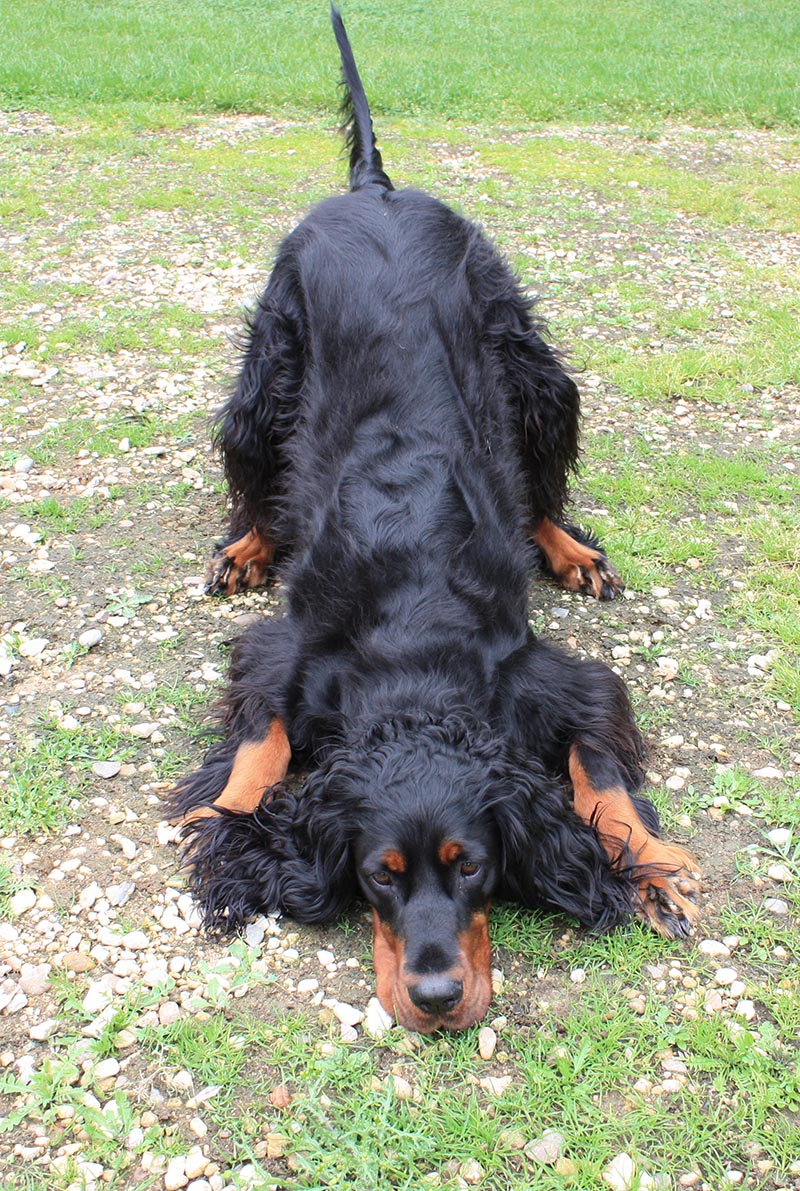
Considering Merrick, the cover girl, and what she is capable of with her insatiable appetite to learn (eat really) which has developed my deep respect for dog capacity: in cognitive skills, memory, controlled movement and to entertain with more questions and answers. If you are hooked on these super-learners then you will know what I am talking about. Dear Merrick is just the average learner, nothing terribly specially, but never saying no to some learning.
I hope you find the joy as a teacher of dogs and experience many moments where that joy is reflected through your connection.
They deserve all that we can give to ensure what they learn is for their benefit.
Build The Learning PDF
Build the Future
Through building our learning and developing a deeper understanding of the learning processes we can build a future together: a dog that is curious, confident and resilient with a natural enthusiasm for learning.
Build fearless learning
Very often we are beginners when we first learn the foundations but as an advanced learner revisiting those fields brings greater understanding of the nuanced elements. We learn to question what was previously assumed and accelerate our skills.
Begin your journey with Build the Learning by your side.
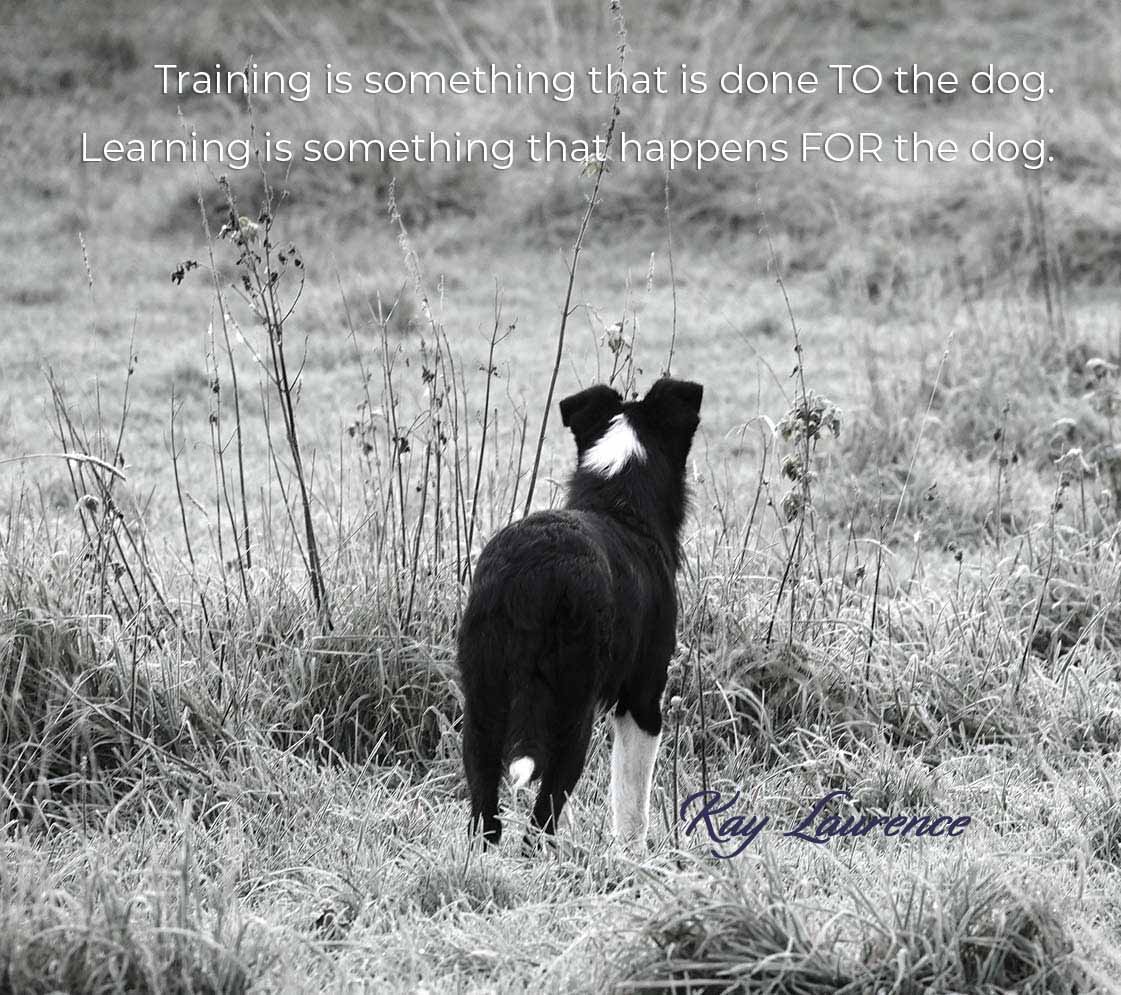
➤ Become a Teacher. Training is something that is done TO the dog. Learning is something that happens FOR the dog. Consider seeing their experience as a process of education.
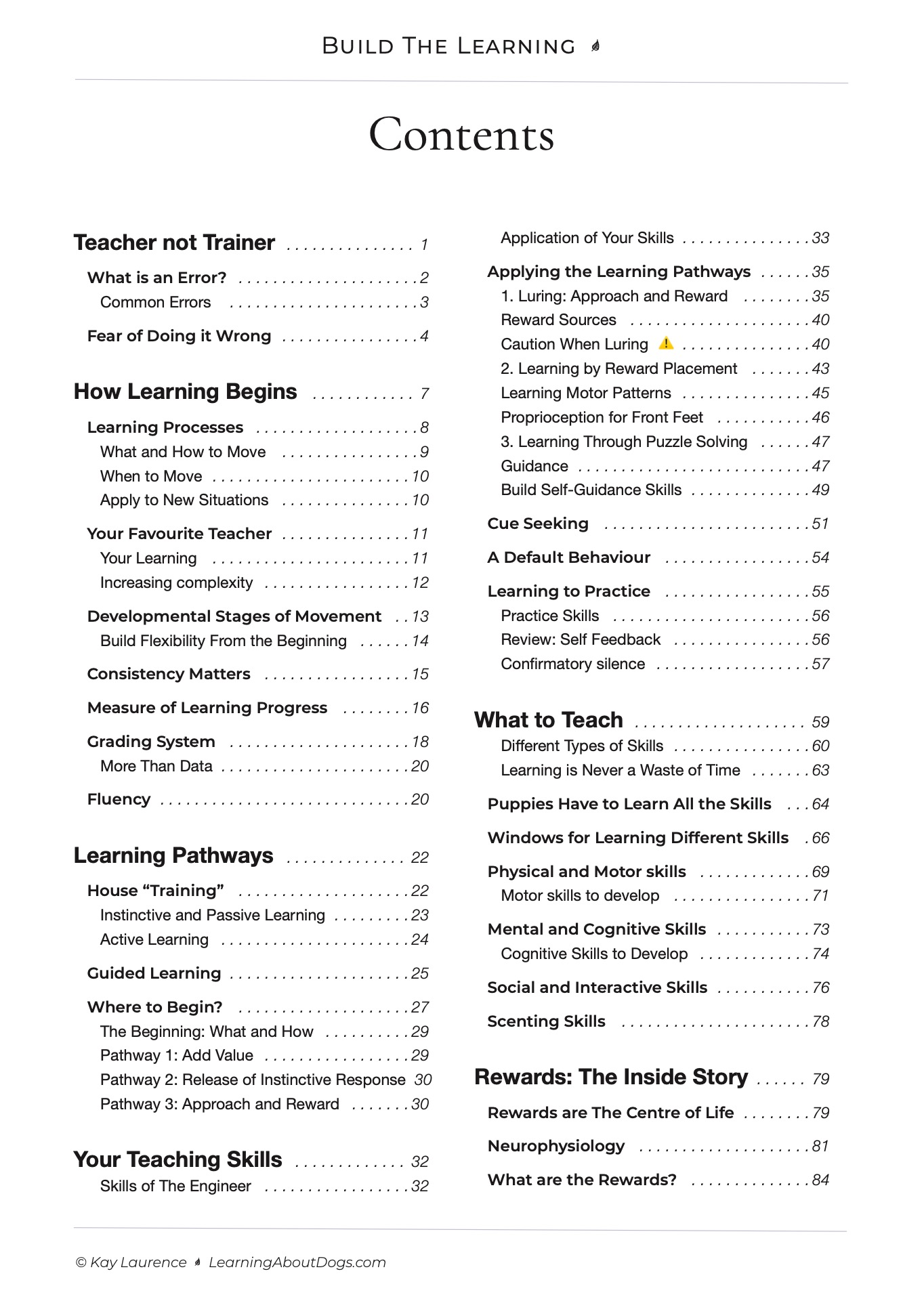
➤ Learning Processes: From the start we ask WHAT to do WHICH muscles must be engaged and HOW they will do it: whether this is carrying a cup of coffee or handwriting, the developmental process is the same for the dogs as it is for us. Learn how to measure progress and the importance of consistency and fluency.
➤ The Learning Pathways: what route should you take? Using the best of instinctive, active and passive learning. How much guidance to include.
➤ Your teaching skills: understanding theory is not enough we need skills learned through application. Explore three key methods and practice your motor skills. Employ cue seeking and default behaviours.
➤ What do you want your dog to learn? Develop their skills for their benefit. What physical and motor skills will be part of their future? Can you extend their mental and cognitive skills and build resilient, creative learners?
➤ Rewards: discover why they are the centre of life and how they drive learning. Improve your understanding of neurophysiology, reward value, reward variety and reward prediction error. How you deliver the reward is as important as the reward itself.
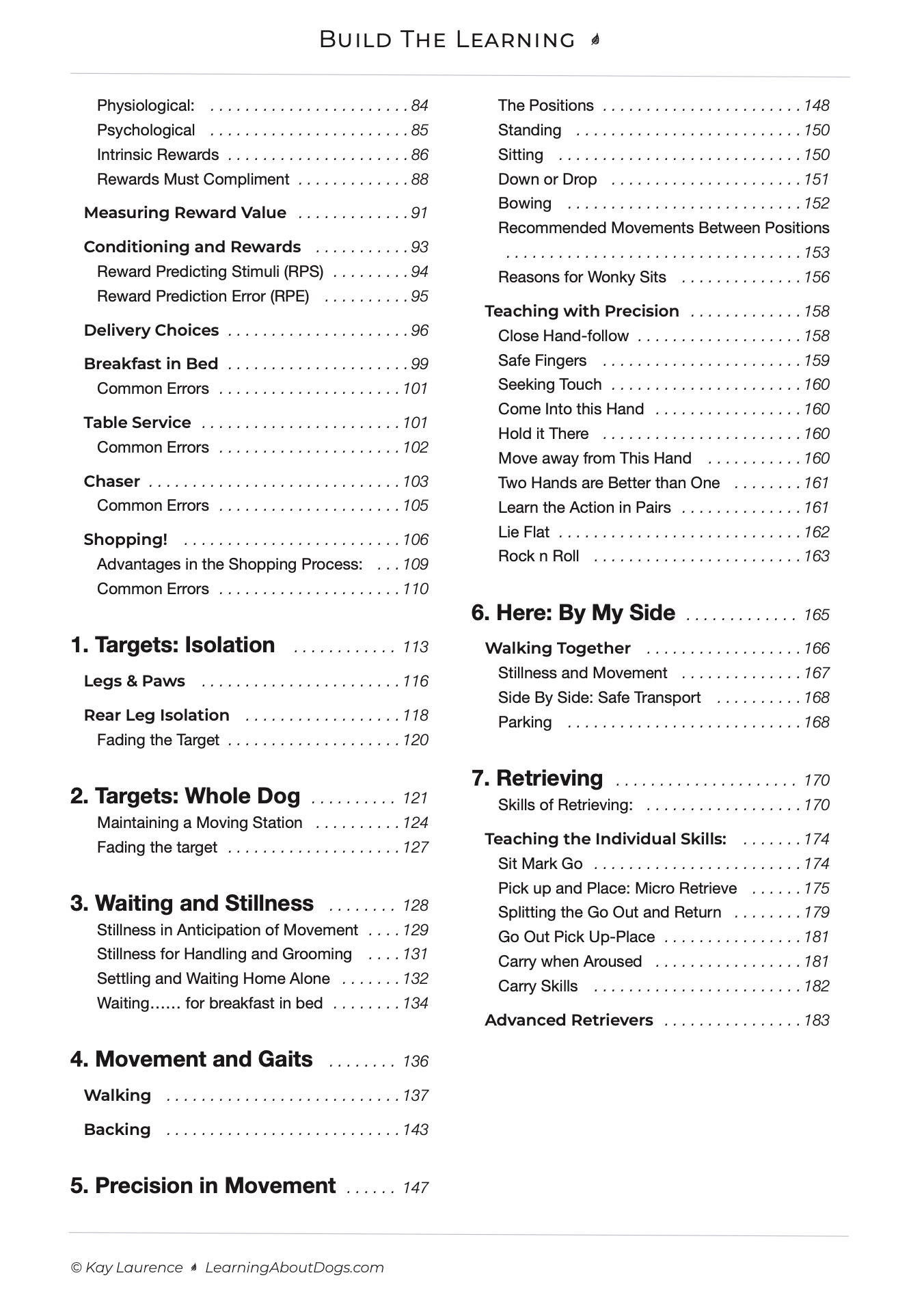
➤ Learning Activities: where the learning comes to life. Seven sections examining many routes to the best results: isolated targets, holistic targets, stillness, movement, precision and the retrieve.
A combination of the Reward Skills, Management or Training and Build the Learning workbooks with practical activities for skill building. 184 pages.
Learning is about making changes.
Changing your mind.
Changing the way you see dogs.
Never be too busy to learn.
Inspiration begins with dogs that ask more of us .....