
Teaching People: more than rewards and reinforcers

I want to explore some of the learning theories that go beyond the historical sources we are encouraged to employ (Pavlov, Skinner, etc.) and consider whether we can make use of new technology and innovative techniques not only for our clients but also our dogs.
Diving in at the deep end:
The Cognitive Approach
We become familiarised and somewhat channelled into the behaviourists’ models of reinforcement, punishment, shaping, extinction; this can prevent us from looking outside the windows for either dogs or people. Our training style of seeking to reward desired behaviours can bleed over into our teaching styles with people. I was once advised to reward successful students with “doggy dollars” and although this may have been an ideal temporary step for college aged learners to help them focus, it failed to make progress towards significant learning that is lasting and comprehensive.
Knowing the theory of how to achieve the perfect recall, or loose-lead (leash) walking is insufficient. Our responsibility should move further into education and teaching a person for every dog that shares their lives today and in the future.
To quote Fosnot (1996) “We run the risk of short-lived solutions (reform) unless professionals teaching people also understand the theory behind the practice” In the current climate, this means going beyond training outcomes and discussions of what tools we should use to achieve them. We can help people to be able to :
- Understand what they are trying to achieve to a depth where they can adapt the recommendations as the dog’s learning, and their skills, progress.
- Build their own learning pathway through their experience and discovery through application. Not just trying to imitate someone with a different skill set or ethical approach.
- Be able to process what they are seeing and make their own decisions that align with their beliefs and values, or in current speak: avoid getting scammed by fake media.
- Compile all the new information with their current views and knowledge and prune much of the chaff that we can inherit through the “but I was told ….” systems.
This may be a more effective investment to a permanent and long-lasting change to the world in which dogs live by considering our approach to our instructional techniques, not just pointing fingers and fighting over best, better or just good enough.
The existing techniques of presenting the classic recipes with a new glossy coating are like chucking leaves into the wind of social trends. People deserve to learn more than the perfect recall or loose-lead jiggery and dogs deserve significant changes in our approach to their learning.
Changing the world in which our dogs live means a deep investment in the way people view their dogs and their role within their lives, and this will come from the dog professionals and their respect that dogs deserve quality learning, not just training.
Instead of the marketing focus on the needs of the bill-payers by preying on perceived weaknesses—the reactive dog, the pulling dog, the running-off dog, the jumping-up dog—can we be looking at the education of the dog for the benefit of that individual in terms of the skills they need to be able to live with people? By changing this focus people can begin to see a dog with their own rights to live a good quality of life that goes beyond compliance, obedience and removal of rough, or any, edges.
Cognitive learning can be uncomfortable as a person’s existing system of understanding is questioned.
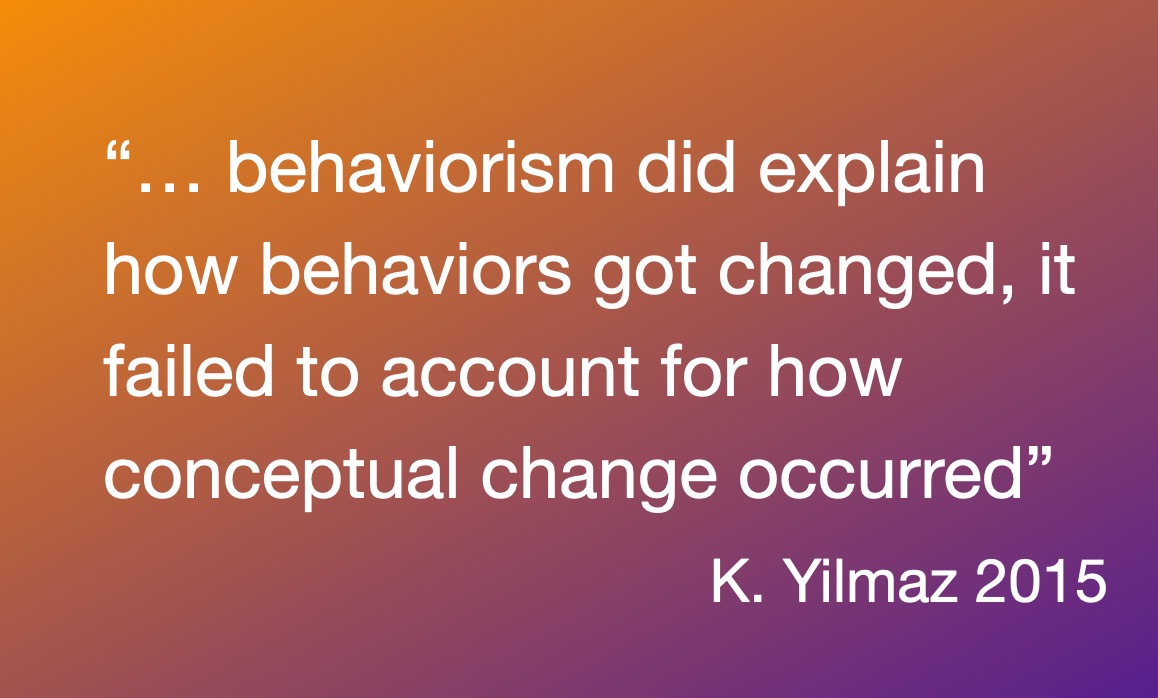
Whilst they go through this process clients may resort to three kinds of reaction:
- Disregard the contradictions and stick with what they are familiar with
- Vacillate (dither) by trying to do both the old and new ways but not blending them successfully
- Form a new understanding to explain the difference, the contradiction
All of us will have an individual ways of sorting the information and the knowledge we acquire. This requires us as teachers to find an array of different ways to explain and visualise the understanding.
Some may need logical explanations, in the case of lead management:
➤ the physics of attached opposing forces, or
➤ a greater understanding of how our hand movement can affect the dog’s perception of the situation: are we tense in expectation of a sudden surge from the dog; (clenched fists, wrapped leads, tight shoulders, fast hands), which may make the dog more likely to surge?
➤ others may need to feel what we are changing will be for increased safety or as a series of cues for their dog.
All of this understanding is relevant to all learners but it is how it is individually processed and blended with previous learning is a key significance to making long lasting changes.
I see my learners begin with an enthusiasm based on wanting to do it the right way, but through time this matures to a much deeper series of really good questions about the way their dogs live beyond teaching a sit for greeting or a settle in social circumstances. “Be quiet, do not be seen or heard” can be achieved with a subscription to reinforcement systems but with zero consideration that the dog is considerably stressed, uncomfortable and trying to communicate a desire to leave this situation.
The marketing term “loose-lead walking” is used to attract interest whereas learning the skills to move side by side in a synchronised fashion is most certainly a concept and more of a dance with depth and complexity.
I see a more comprehensive learning experience when a cohort of similar learners interpret the activities in different ways for themselves and their own dogs. This is a joy of shared learning and shared videos: one person’s application of the process brings a revelation to another. In tandem with this is the energy it gives the group: a desire to share the same experience and push further, to not be left behind. One person’s learning can belong to everyone.
With the in-house classes the relevance of lead management learning becomes apparent when the Water Jug Game is included. This involved the team, person and dog on lead, to travel a set pathway negotiating various obstacles: walking around chairs, stepping over poles, passing a person noisily eating crisps, through a narrow gateway and all the while carrying a full jug of water. Kudos was offered for the person that completed with the most water but everyone was a winner in terms of understanding through application and enjoying the success of their peers.
The post-class session of cake and coffee allows for reflection: what learning happened? Was their understanding changed?
This has not a thing to do with loose leads, right or left side, heeling, or other traditionally perceived notions about walking the dog. How you managed this task was a personal choice: sudden movements would be self-penalising: consequently clear communication to the dog, both verbal and through the body language and energy, was critical.
As these skills are being learned, which can be massively different for each team, authentic situations can present dilemmas to be resolved: can you carry that tray of drinks from the bar to the table? With dog?
From the basic understanding we can apply the learning to further development: passing interesting situations that may divert the dog, equally move away from potential complications and this can be graduated to complex environments over time. Each learner will need to process their options, evaluate the situation, consider reward and reinforcement strategies, cues and safety. Through this process they will become more competent and construct their own solutions: for all the dogs in their future.
This is not the route of copy me, do it like this or other bland recipes and magical tools. It is not simple or straightforward, it can take several weeks to achieve or even months and a conclusion that “walking the dog” is not a beneficial or necessary activity.
Today’s Technology
Learning within a group situation, particularly where videos are available of individual experiences, builds a wider understanding of the concepts and give valuable, constructive feedback and support. Not everyone will be learning from the same history and participate with the same skill set, it is the role of the teacher to illustrate the commonality of the concepts and how they relate to diverse examples.
Today’s access to multimedia allows us to build excellent learning material that can dispel some of the anxieties that adults can experience when returning to a learning situation. Visual learning—learning to analyse (video) instruction, learning to observe and comprehend the important points, often at the micro level—becomes the new set of learning skills. This can be developed alongside discussions, stories, reflection and shared experiences.
Learning together is the new school and as much of an important process for the teacher as any individual learner; but this must allow for individual progress that is without comparison as a dachshund will not be progressing in the same way as a doodle of any blend.
Where learners are making massive changes to their beliefs and values through this voyage of discovery they may need more information about the potential cost of previous learning that was unseen or measured at the time, due to their inexperience.
Next: can we consider the Cognitive Approach to learning for our dogs?


