
Cognitive Approach for the Dogs

This is the next part of considering modern teaching strategies: the previous part is here: ➤
I would like to bring a whole bright, warm Summer’s day to considering this approach for our dogs: in all that they learn. Do not think “oh, this is just training again”. No, learning for their own benefit: how to move their bodies well, process the confusion of the worlds around them and not sink into an inability to thrive as the weight of our expectations loads them down. .
The four key points of the cognitive approach used in teaching people:
➤ Understand what they are trying to achieve; to a depth where they can adapt the recommendations as the dog’s learning and their skills progress.
➤ Build their own learning pathway through their experience and discovery by application. Not just trying to imitate someone with a different skill set or ethical approach.
➤ Be able to process what they are seeing and make their own decisions that align with their beliefs and values, or in current speak: avoid getting scammed by fake media masters.
➤ Compile all the information that is available with their current views and knowledge and prune much of the chaff that we can inherit through the “but I was told ….” systems.
How does this translate to adapting the dogs’ learning with a cognitive approach and a respect that it equally can be applied to them as for us.
Understanding what they are trying to achieve
This goes far beyond just doing it. We build a serious amount of expected responses through classical and operant conditioning: “here to me” with name and the “come” where the response is well rewarded. “In your bed”, “off the sofa”, “get it”, become cues for established learning and we begin to believe they “understand” what we want.
No, they are able to connect the sounds under specific conditions with established reward opportunities. This often occurs through extensive repetition, I recall the recommendation from a reputable source that it would take 734 repetitions to establish a “Sit, good sit”. Snort.
This conditioning-by-drilling is considered sufficient to meet the everyday expectations, but have we considered how the dog experiences this? Is this contributing to a dog that thrives? Would you want to be on the receiving end of that (parenting) attitude, or boss at work or other family member?
Building learning where we seek to achieve an understanding will begin with the usual foundational processes communication through luring, targets, reward protocols that shape the learning in a form that is best for that dog. Not a one-method-suits-all, but a system of adaptation that makes their learning most likely to be retained: a specific speed of walking side by side that allows to them to sniff what needs to be sniffed, moving in a gait that is variable and comfortable and also meets our requirements of mutual safety.
Living with two breeds that do not share common purposes means that the same outcome will follow a different pathway: walking a Gordon is not the same as walking the Collies. They have different interest, desires and limitations. Gordons will be strongly drawn to the medium of scent whereas the Collies will be watchful for those moments where I explode into desired actions: a ball may have emerged from my pocket in April 2020 and they do not forget.
From the foundations where we explain the behaviours that achieve the results, we then set up circumstances where the dog can transfer that learning to similar situations. The more this transfer occurs, the more circumstances where it is applied, the deeper that understanding becomes. This begins to nullify the need for excessive repetitions.
I teach both breeds as youngsters the skill of measuring closing perceptive distance. You can see Todd go through the process here.
He is learning this initially at the micro level measuring the distance with single paw movement and stepping up onto a brick and this graduates though a set pathway to trotting onto a platform arriving with the precision to be able to adopt a forward sit without hesitation.
When a dog has not learned this visual measurement on approach their arrival is often clumsy, with some overshooting and leg adjustments to achieve anything resembling a (good) sit.
With the Gordons this is a safety requirement as crashing with equal force into both people and trees is quite common. Watch here...
The pathway of using the targets to build this skill I can then measure their understanding in the skill of perceiving the exact spot She needs to elevate to land on the toy. This was NOT taught with the toy but a demonstration of the transference of the skills she has learned applied to different conditions.
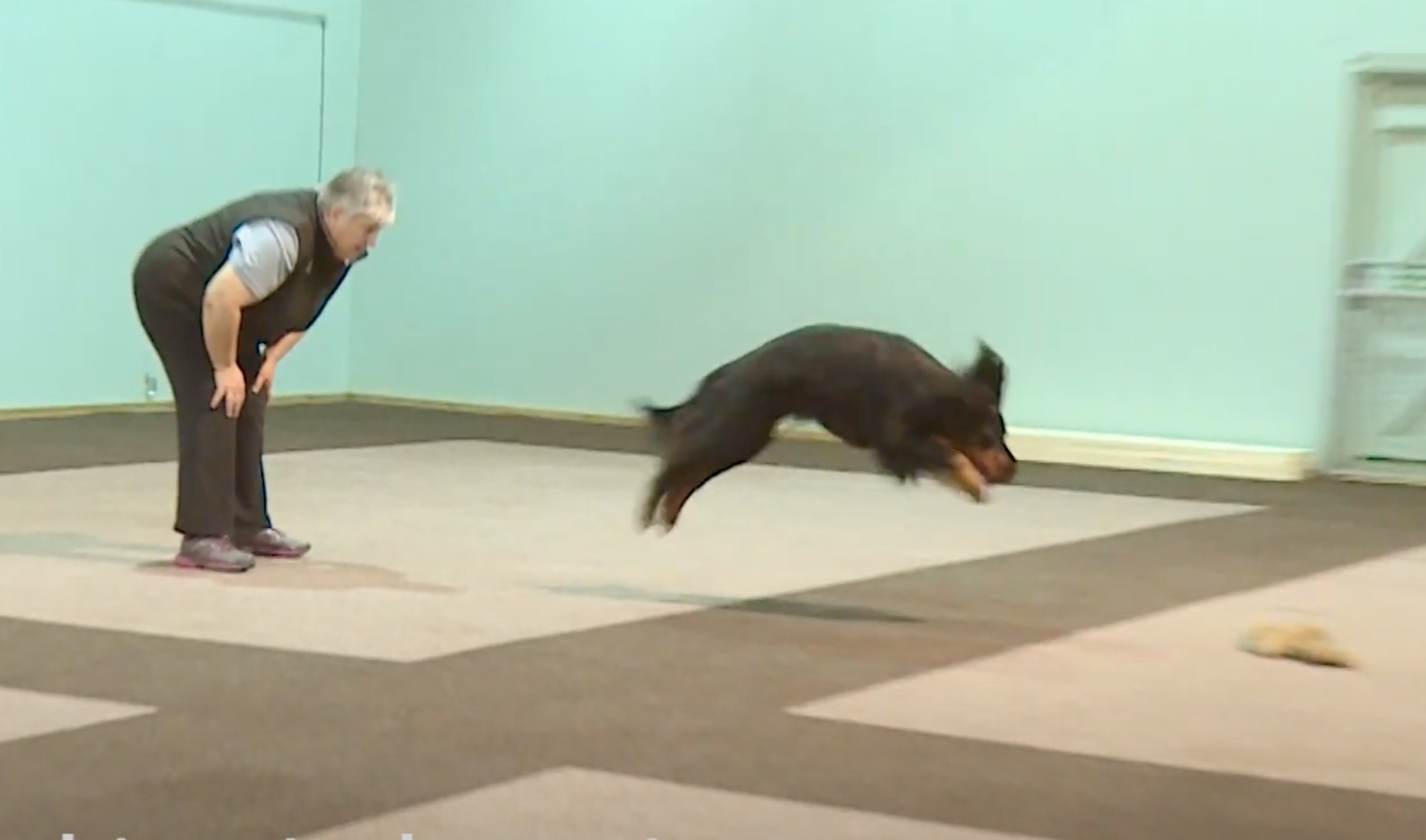
Seeking evidence of understanding is an approach that requires us to clearly communicate the foundational learning and then credit the dog with their ability to show us what they have learned.
This is their question, “is this what you wanted me to learn?”
If we do not give space for that extra time to ask questions and instead forge onwards with the next 716 repetitions we are insulting our dogs’ enormous capacity to learn: when given the time.
If we do not check their understanding we can travel a long way carrying forward a misunderstanding. This happens with people on a frequent basis: I asked a visiting friend from the States who runs her own dog business if she would like to take my Wednesday evening class? There was an enthusiastic, affirmative response. But at 8pm we both stood for several minutes not understanding why nothing was happening, I was waiting, she was waiting. Misunderstanding of the term “taking a class”. In the UK the teacher takes the class, in the States it is the student.
I teach all dogs how to move backwards in a straight line. Big dogs in small kitchens are often required to back out, thank you. I discovered on further questioning through adapting the understanding that the Collies usually learn a movement that results in a backing action, but the Arnold, Gordon Setter had learned to increase the distance between me and him. Both outcomes looked the same. The Collies could adapt this learning-of-movement through coming towards me tail first, Arnold could not, but he could shimmy backwards in a down position.
Build their own learning pathway through their experience
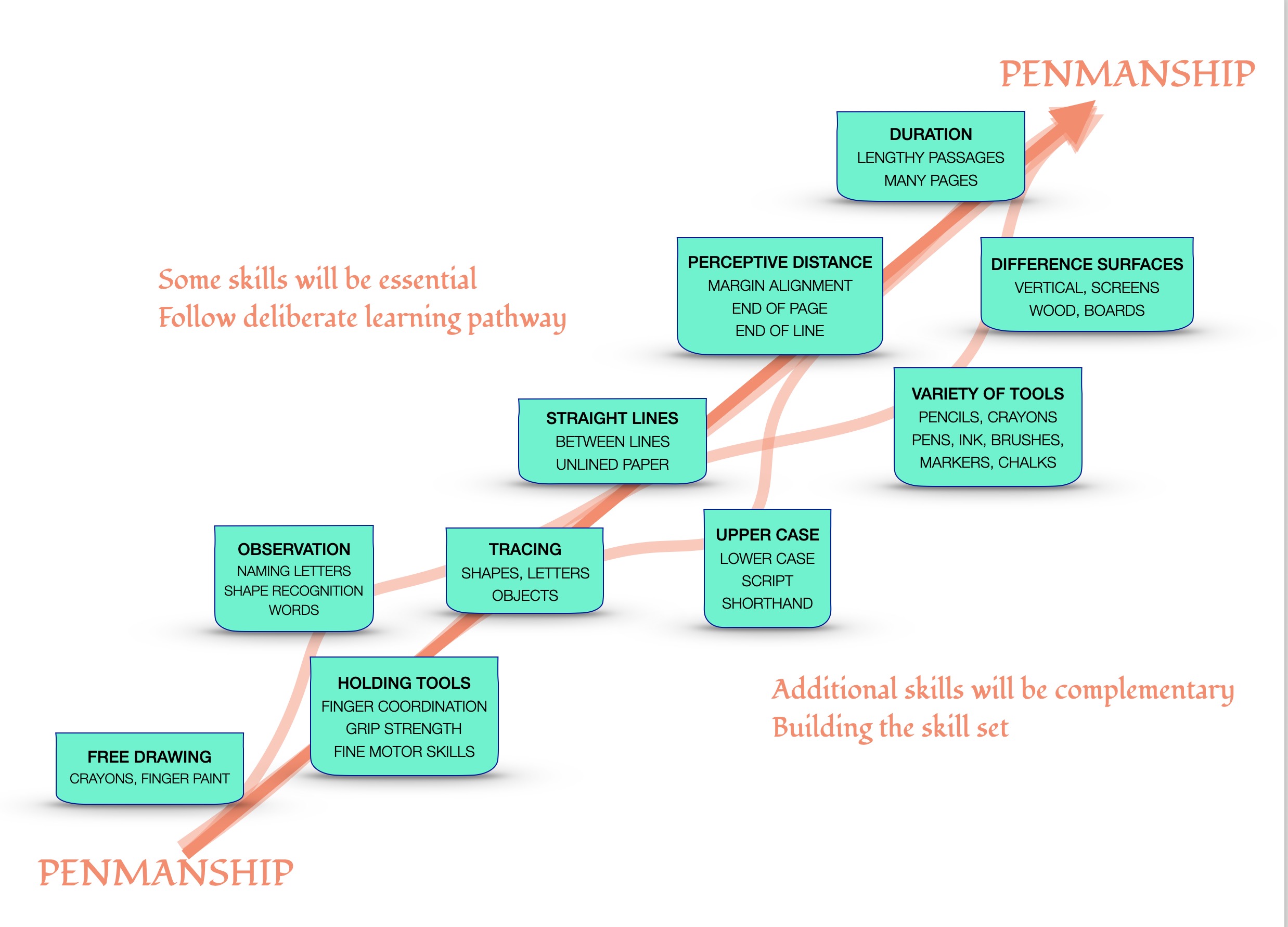
A learning pathway is frequently laid out in the order the tasks will be completed. Do we pick up the pen to write or think about what we want to write and then pick up the pen? Does the desire to communicate in that medium come before the skills or are the skills able to create that desire?
Motor skills, such as holding a pen, will need to be taught with great care for this is a critical lifeskill. The learning pathway travels a deliberate route and along the way collects adaptations of the skills. Stimulating or creating a desire to write could arrive at any time on this pathway, or not at all.
We may have a dog with a strong desire to carry objects and this can be carefully shaped into an organised activity or we can have a dog that sees no logic to carrying objects that may benefit from learning on a structured pathway.
The natural carrier may experience the loss of that object when in the proximity of people, they may even throw it a long way away, and they will learn to avoid a future of retrieving. The dog that enjoys the chase down aspect may build a pathway of carrying and returning the object to the repetitive throwing machine.

Each learner will need an individually tailored learning experience even if the goal is similar. We can no longer consider that all dogs would gain the same pleasure from the expectation of the retrieve exercise. Both penmanship and retrieving requires motor skills to be learned in a specific order, to a specific standard to enable progress. Even the “natural” retriever may have poor eye-mouth coordination or the ability to assess how to pick up or carry a novel object.
The learning pathway is a mixture of required motor skills and personal experience. We can no more dictate that for people as we can for dogs, as a left hander learning in a right handed world I can provide personal evidence that the struggle to learn penmanship certainly affected my desire to write.
Still hate it and am well skilled at avoidance.
Be able to process what they are seeing and make their own decisions
This is a respect for the individual, as a dog, to be able to make decisions that are for their own benefit, and not for the agenda of others. This is often dismissed in the social situations where we want the dog to “be friendly” to other people, other dogs, and impose our own social perceptions onto the dogs. As a species they have developed very clear and acceptable social processes which may not align, or have any resemblance of similarity, to ours. In an effort to avoid embarrassment or use the dog as a social tool we have created some outrageous protocols to fix the dog to meet our (self-centred) desires.
Given the time and space to be able to create social skills in their own way, dogs can be seen to adapt but this needs to be their own process, not ours.
Illustrations would include the misnamed “socialisation” activities to get our puppies comfortable in our confusing world. When this is forced the outcome can be the opposite of our intent. When given credit that they can and will process the weirdness of our streets in their own way and at their own rate we can see them make decisions about what they consider is something to avoid, or makes them feel fearful. Desensitising pups to traffic is like trying to desensitise you to tigers, if you do not understand that the tigers are safely contained it will not stop you being fearful. I want evidence that the barrier is solid, regularly maintained and does not contain an unlatched gate. This may take time and I may never trust that the safety inspectors are working to my standard.
Compile all the information that is available with their current knowledge
Many of us travel with our dogs to new venues: a holiday for a week or two in a new place; a place that they have never visited with completely new smells and different layout. We move house and we want our dogs to be able to “make this home”. This may take several weeks or months; what constitutes home for a dog may be quite different to our idea: safety, routine, predictable events, familiar scents and furnishings; or it may be simply our own sense of home that gives the dog all the information they need.
Working and sport dogs are doing this on a regular basis: the sheepdog that travels for several hours to collect unknown sheep from an unseen destination that behave in a “ non-standard” fashion.
The search dog that is negotiating alien terrain in extreme conditions.
The competing dogs that are mixed with unknown dogs and people, in the strangest of venues.
It is building the skills of adaption for many months and through all their activities that contributes to these exceptional dogs. It does not happen by accident and nor can it be forced. We must plan to develop a good standard of the foundations skills and then invest heavily on the adaption through gradually changing their experience. They will need to find the similarities, recognise what is the same and what must be changed to achieve the desired goal.
This is a critical part of learning: you will not drive the same car for life you will need to adapt; traffic conditions will be constantly evolving along with the technology. Learning good foundation and adaptation skills will make a lifetime of driving minimally aversive. [I hear you snort]
For all the dogs that will share our lives they will not be the same and we will need to constantly growing and revising our expectations and ways of communicating.
As learning technology moves forwards and develops innovative strategies in the world of education we should be considering that it is also the right of our dogs to be respected as learners with their own agency and not just objects to be trained.


