
Ear Myths

There is a myth surrounding Border Collies that ear shape, coat colour or texture, and even eye colour are indicators of that dog’s personality, temperament, or behaviour: for example, it might be said that a long-coated red dog is sensitive; a dog with pricked ears is tenacious; a dog with amber eyes is gentle. Now, before you look at Bess lying by your feet and whisper “I didn’t know you had it in you,” don’t worry; she probably doesn’t!
In a way, once upon a time these ideas may have made sense: a dog may have inherited elements of their working style and their physical characteristics from their parents; their siblings may have exhibited similar traits; it would therefore be a useful mental shortcut to assume that a dog who looked like Sweep and his line might behave and work like Sweep and his line.
This idea has also probably been given credence from an oversimplified understanding of Dmitri Belyaev’s experiments in the fur industry in Siberia when he set out to select and breed tame foxes, discovering in just a decade that the domesticated foxes had floppy ears and curly tails, and seeing certain predictable changes over generations in their coat patterns and colour, and face and body shapes. While it is increasingly accepted that we can’t select for behaviour without affecting physical appearance (or vice versa), to believe that physical appearance is an iron-clad guarantee that behaviour (or temperament, or personality and so on) is an oversimplification.
To say that a red coat means that the dog who wears it is sensitive makes as much sense as saying that all redheads have fiery tempers (sometimes I wish I did! I know a few people who could benefit from encountering it)…these are myths with absolutely no basis in reality. While they may be true for one or more redheads or one or more red-coated dog, this does not make them universal. Let’s take a look, with the provisio that this information is simplified for the purpose of demonstrating the point that coat colour does not determine a dog’s “nature.” For those who prefer a deeper dive, approach with caution.

Do these evenly balanced ears mean he has a balanced nature?
Does the one blue eye indicate he is of a devious nature or quite determined?
Would it matter if this was his left eye or right eye?
The Look of a Dog: It’s All About Pigment
Sweep has 39 pairs of chromosomes in each of his cells; of each pair, one chromosome has been kindly donated by his mother, and the other by his father. These chromosomes hold genes that contain specific instructions that determine Sweep’s appearance and how his body works to make Sweep who he is.
Sweep has about 19,000 genes, only a small number of which have anything to do with the colour or texture of his coat, the set of his ears, or the colour of his eyes.
There are two types of pigment responsible for coat colour: eumelanin is by default black, but genetic expression can cause it to take on brownish or greyish hues (liver and blue coats, for example). Phaeomelanin, which is red, can become cream, yellow, gold, or even orange depending on the genes (yep, the same pigment that’s responsible for my red hair and freckles).
Sweep’s genes decide which cells should produce eumelanin or phaeomelanin, and sometimes they decide that some cells (coat pattern) shouldn’t produce any pigment at all, resulting in white. This information is dictated by the genes he has inherited.


Border Collie Coats
Border Collie coats come in a wide range of colours, markings and length: solid, bicolour, tricolour, sable, and merle included; soft, medium, long (rough).
Some of these traits are dominant, (like the colour black, or the patterns merle and sable) meaning they will be expressed if one of the dog’s parents is a carrier. Others are recessive (like the colours red, blue, gold, lilac, or the pattern tricolour), meaning they require both parents to carry the genes for them in order for them to be expressed.
The colour and patterns of Sweep’s coat are not merely a matter of replication of the visual appearance of his parents, but their own coat colour genetics and the genes they respectively pass on to Sweep.
With such a small number of genes involved in coat colour, then, and with inheritance being far more complex than the traits that the parents exhibit, it doesn’t appear to make any sense to suggest that a dog’s coat is a predictor of their “nature.”
What we do see, however, is that it significantly influences human perception. Anyone who’s attuned to how certain colours of dogs and cats are overlooked for adoption from shelters, or who have experienced people crossing the street to avoid their friendly black dog will appreciate this.
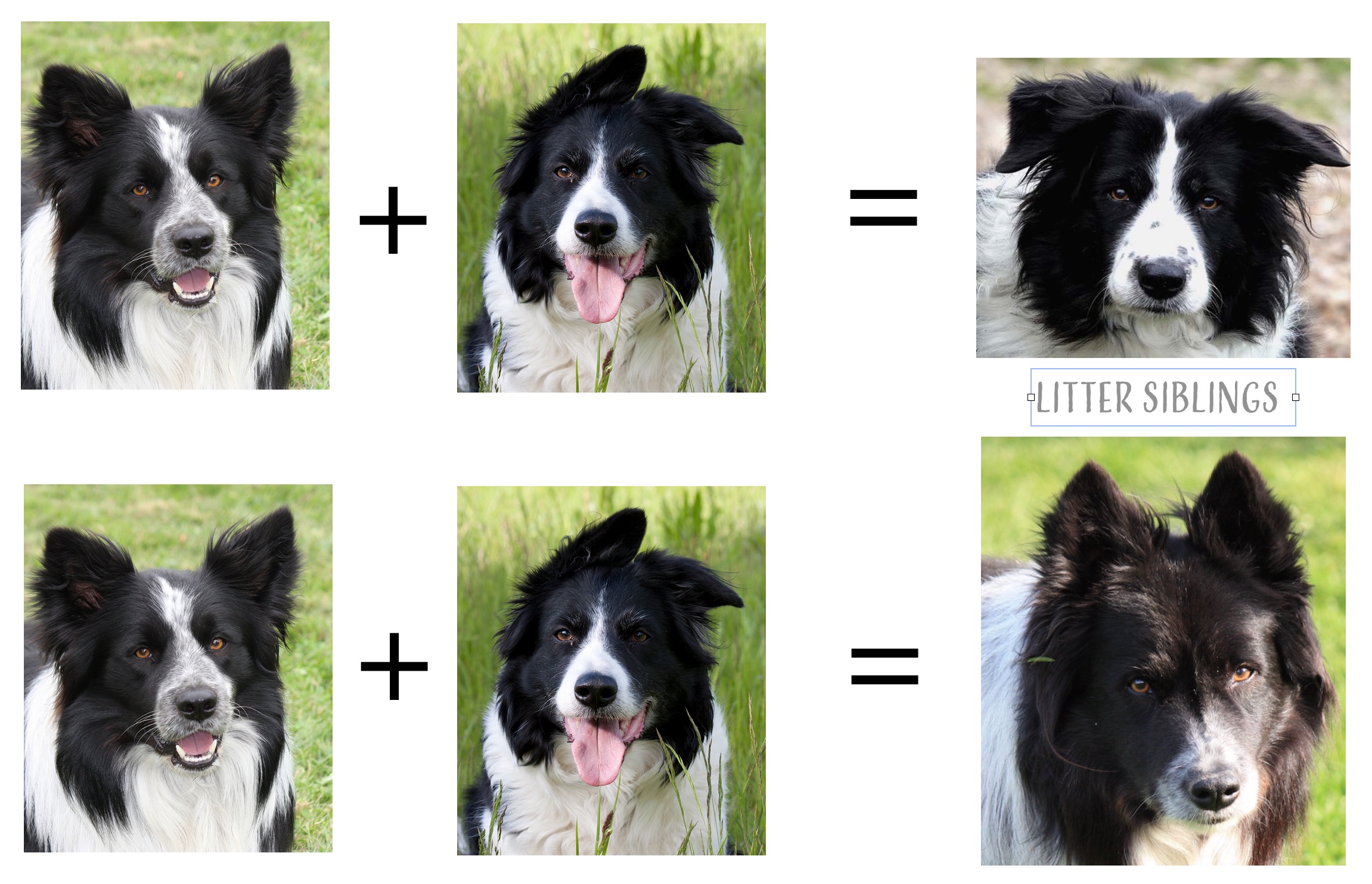
Border Collie Diversity
It should be clear that Border Collies are incredibly diverse in appearance: the carriage and shape or their ears; the colour, patterns, markings, texture and length of their coat; the colour and shape of their eyes; the set of their tail; their body mass and shape. Since these dogs are a type, and were never originally what we would refer to as a “breed,” we can safely assume (and easily observe) that they exhibit as much diversity in behaviour and in working style as they do in physical appearance. To suggest that the handful of genes responsible for just coat colour or ear set or eye colour are predictors of who the dog will be and how they will work seems entirely far-fetched, superstitious and, dare I say it?, irresponsible.
The heritability of behavioural and working traits is still hotly disputed: the mode of inheritance of working behaviours is complex and polygenetic, and there persists research into how individual genes can control multiple characteristics. What this means, then, is that it is possible that a dog with a smooth, medium-length, red coat; pricked, pointed ears; and amber eyes might show certain behavioural predispositions as a result of their genetic inheritance. But a predisposition is not a guarantee.
What it doesn’t mean, then, is that those behavioural predispositions will determine how the dog behaves. That is a matter not only of their genes but also of their experiences, their learning, their environment. To predict that a red Border Collie will be sensitive is as sensible as telling this redhead that she’s fiery by default…and at that, I will gently close my laptop, breathe slowly and gently, and go and dance barefoot in the woods.
References and Further Reading
Arvelius, Per, et al. (2013), “Measuring Herding Behavior in Border Collie—Effect of Protocol Structure on Usefulness for Selection,” Journal of Veterinary Behavior, 8: 9-18.
Coats and Colours, https://coatsandcolors.com/punnett-squares-inheritance-of-coat-color/
Delgado, M.M., et al., 2012. “Human Perceptions of Coat Color as an Indicator of Domestic Cat Personality.” Anthrozoös, 25.4: 427-440.
Dog Genetics, http://www.doggenetics.co.uk/
Dugatkin, L.A. and Trut, L. (2017). How to Tame a Fox (and Build a Dog): Visionary Scientists and a Siberian Tale of Jump-Started Evolution. University of Chicago Press.
Fratkin, J.L. and Baker, S.C. (2013). “The Role of Coat Color and Ear Shape on the Perception of Personality in Dogs. Anthrozoös, 26.1:125-133.
Ostrander, E.A. and Wayne, R.K. (2005) “The Canine Genome,” Genome Research 15: 1706-1716. https://genome.cshlp.org/content/15/12/1706.full.pdf+html
Storteig Horn, S., et al. (2017) “Genetic Analyses of Herding Traits in the Border Collie using Sheepdog Trial Data,” Journal of Animal Breeding and Genetics 134.2: 144-151.
Weir, Malcolm (2024) “Genetics Basics: Coat Color Genetics in Dogs,” VCA Animal Hospitals. https://vcahospitals.com/know-your-pet/genetics-basics-coat-color-genetics-in-dogs
Diagrams and photos by Kay Laurence with Collie icons by Hayley Hunter of Hillside Creative.


